This weekend, a superhero film hits theaters that is a must-see for fans. It’s full of great characters, has many big surprises and twists, includes amazing sets and costumes, and is wildly entertaining. No, not the latest Avengers movie — although, as my review of that film makes clear, you definitely should see that, too. I’m talking about writer-director Jon Schnepp’s wonderful documentary The Death of Superman Lives, What Happened? opening this weekend in extremely limited release. Schnepp has done fans and history a great service with this film, telling a story that otherwise never would’ve been heard — and showing us artwork and designs that never would’ve been seen, which would’ve been a major tragedy. The film has limited screenings this weekend, before its release on VOD and Blu-ray on July 9.
I’ve complained in articles in the past that the Oscars frequently fail to nominate more unique and diverse films in the Best Documentary category, and The Death of Superman Lives is precisely the sort of creative attempt to tell a story that would never have been told, and with an internal narrative that — as you’ll see when I discuss the film in detail below — demonstrates a clever method of completely upending audience expectations with a setup that intentionally gets viewers thinking in a way the filmmakers are determined to ultimately undermine and eventually reverse entirely. It’s the best documentary I’ve ever seen about superheroes and the comic book film genre, and it’s about time the Academy gave it some love… or, if they don’t, then next year they can just expand the Best Documentary category to ten films or something…
The film’s release in a handful of theaters means it’s not going to join Furious 7 andAvengers: Age of Ultron in breaking any box office records, of course. But the subject matter and its appeal to some hardcore fanbases means it should enjoy good theater averages in the few it plays in. It’s the Blu-ray where most of the money will come from, while the potential on VOD is quite interesting. I’m not sure how documentaries tend to fare on-demand, but there is enough interest in this project and its topic, and the genre in general, to help it get the attention of mainstream viewers. Plus, there are so many high profile interviews, and so much never-seen footage — including Nicolas Cage in several super-suits, and some test footage of flying — that there’s reason to think it will do okay (for a documentary) on VOD.
Schnepp funded the documentary on Kickstarter, as well as out of his own pocket, and it took years to complete. He was literally up the night before the Los Angeles premiere doing final edits and suffering through some frustrating technical issues. But the final result is impressive and a joy to experience.
For those unfamiliar with this documentary’s topic, Warner Bros. set out to make a film called Superman Lives, based in part of the comic book story The Death of Superman. The film would tell the story of Superman’s death and rebirth in a story starring Nicolas Cage as Superman, Christopher Walken as Brainiac (yes, seriously), and Kevin Spacey as Lex Luthor. The original script was written by Kevin Smith, and the film was to be directed by Tim Burton.
The first trailer for the Left Behind reboot is finally here. For those who don't know what Left Behind is (you're going to Hell), it's a very popular 16-part series of Christian novels about the Rapture. The first in the series was made into a straight-to-DVD movie in 2000 starring Growing Pains' Kirk Cameron. Now the production value has been increased (as it couldn't have been decreased), and freaking Nicolas Cage is the star. The trailer has a lot more God talk than your standard action-movie trailer but is actually kind of coy about it all. Maybe they're hoping they'll be able to convert the general action-movie audience. You know, just like how there are now all those churches dedicated to Godzilla.
For those of you unfortunate enough to have actually paid to see 1994's Trapped in Paradise, there is comfort in knowing that it could have been worse.
Your life was diminished for only a couple of hours. Consider the plight of Nicolas Cage. The poor guy was in the stupid movie, which was filmed during the coldest winter in Canada's history.
His comedy career did not survive the winter, but the experience did teach him a lesson about the kind of movies he should be making.
After Trapped in Paradise, he vowed to return to the more serious, and often offbeat, roles that marked his earlier career. In Leaving Las Vegas, he plays a suicidal alcoholic.
''I got lucky with Honeymoon in Vegas and It Could Happen to You, and I thought I was on a roll. The script for Trapped in Paradise played well on paper, and with Dana Carvey and Jon Lovitz on board, I couldn't see how it could go wrong.
''Then, about halfway through the shoot, everything just exploded. I'm not into assessing blame, and, frankly, I don't know who was at fault. All I knew was that I couldn't go through something like that again.
''I wanted to return to the movies I started with, movies like Vampire's Kiss and Raising Arizona. I needed to get away from these comedies. Then this script for Leaving Las Vegas came in, and it was the answer to my prayers. It's the only reason I got through that experience in Canada alive and sane.''
Leaving Las Vegas is not your typical love story, and therein lies the appeal to Cage.
''I suppose every movie has a message of some sort, but the message of this movie is not anti-drinking,'' the 31-year-old actor said. ''I never wanted it to seem like I was getting up on a soapbox.
''If anything, I think the message is that it is possible for anyone to find true love.
''I'm not sure you could call this a hopeful movie,'' he added. ''But I think it has something to say to people who maybe are at their lowest.''
Cage said he understands that many moviegoers are not going to be thrilled about seeing a downer. That doesn't mean he cares if his movie depresses you; he simply understands your feelings.
''Believe me, I understand that people don't want to be depressed by a movie. But just as comedy serves a purpose, which is to make people laugh and forget their problems, so does tragedy.
''Maybe tragedy helps us all deal with losses in our lives.''
Cage has never shied from tough films. From Birdy to Vampire's Kiss to Wild at Heart and Red Rock West, the choices reflect the actor's sense of adventure.
A native of Long Beach, Calif., Cage was born the son of an educator and a dancer but chose his uncle's profession. The uncle was Francis Ford Coppola, and he cast his nephew in several movies, including Rumblefish, The Cotton Club and Peggy Sue Got Married.
Cage dropped the family name when Valley Girl came out in 1983. He continued to seek the tough roles, which led to his eating a live cockroach in Vampire's Kiss, playing an Elvis-incarnate in Wild at Heart and a kidnapper in Raising Arizona.
Not exactly Tom Hanks territory.
For the new film, Cage said he studied classic movies about drunks, including Days of Wine and Roses, Lost Weekend and Arthur, with Dudley Moore playing the lovable playboy drunk.
''Every one of those performances was great in its own way, including Dudley Moore's, and I took bits of each one and incorporated them into my character. They were all helpful.''
For his previous film role - a muscular gangster in Kiss of Death - Cage worked out two hours a day for three months to achieve a pumped-up look. His preparation for Leaving Las Vegas took a considerably different turn.
''I think my body went into a state of shock because one minute it was all pumped up and the next, I was trying to look like a bloated alcoholic. I ate sugar, lived on fast food and stopped exercising.
''God, it was horrible. I got all lethargic and felt terrible. But I think I got the look I was going for. I wanted to look crummy and feel crummy, and I did.''
The big question is whether the audience will feel crummy when leaving the theater, but Cage remains unfazed.
''I have a suspicion, and I could be wrong on this, that a growing number of young Americans are tired of the baby food that is being fed to them by the studios. I'd like to believe they're ready for a return to a tougher, harder-edged type of filmmaking. Everything goes in cycles, and maybe it's time again for movies like Midnight Cowboy.
HOLLYWOOD — In a way, Nicolas Cage has become crown prince of the movies' darker realms of absurdity. Think of his wildly contrasting roles: the gawky Bobby Rydell cartoon in Peggy Sue Got Married, the demented Manhattan bloodsucker in Vampire's Kiss, the bad-vibes gangster in Cotton Club.
With these performances and others, Cage has become the odd man out among young American leading men. He's the neo-expressionist screwballer, the spooky-ride king. In Wild at Heart (opening today in Central Florida), he hits a career watershed - playing Bogey-man to a whole Casablanca of oddball actors: Laura Dern, Diane Ladd, Harry Dean Stanton, Crispin Glover, Willem Dafoe and all the others, a rogue's gallery of bent denizens of the road, assembled under the direction of that master of lyrical, childlike horror, David Lynch.
''David is like a criminal director,'' Cage says with admiration. ''He's not concerned with Establishment laws and rules. He just does what he does - and it's honest. . . . He's constantly sculpting and fishing. A scene can turn into a comedy or into heavy horror in a fraction of a second. He's very much a sculptor, a spontaneous sculptor.
''When you talk about various levels in acting . . . the same is true with David in Wild at Heart. It's a very universal film, operating on different levels. It operates on a comedic level. It operates on a real level. And also on that absurdist level. Like, there's this gritty road movie, this gritty love story on the road, emanating through a Wizard of Oz tonality - which gives it more texture and color.''
Atop the movie's amazingly eccentric ensemble, Cage's Sailor Ripley becomes the latest in his string of double-jointed performances. As a free spirit, trapped in another man's image - in this case, Elvis Presley's - Cage displays the lizard-lidded '50s cool of a rock rebel, murmuring lines in a smoky pastiche of Elvis' macho purr. (''Wild at Heart is the kind of movie I wish Elvis would have done,'' he says.)
This isn't just an impersonation - like Kurt Russell's John Wayne in Big Trouble in Little China or Christian Slater's Jack Nicholson in Heathers. It's a multilayered turn with coatings of parody, pop tribute and in-joke. And it may signal Cage's emergence as the ace - or, at the very least, joker - of his acting generation.
Cage, of course, is Francis Coppola's nephew, and, at first, there may have been a feeling that Coppola's virtuosity and success had unlocked a Pandora's box of other Coppolas, including Francis' father, Carmine Coppola; sister Talia Shire; and daughter Sofia Coppola. That, actually, is why Nicolas Coppola, at 17, became Nicolas Cage. He says he didn't want the distraction, at auditions, of being a Coppola, of queries and small talk. So he took his stage name from a couple of offbeat Cages: comic-book hero Luke and avant-garde composer John.
Then, after working for his uncle twice - in Rumble Fish (1983) and Cotton Club (1984) - Cage made a breakthrough, under Coppola's direction again, in Peggy Sue Got Married. There has been something nutty about Cage's roles ever since: the hapless convenience-store thief in Raising Arizona, wild man Ronnie Cammareri in Moonstruck, the yuppie would-be vampire of Vampire's Kiss.
All these performances, on one level, are jokes. But they're serious jokes. There's real pain and anguish and a sense of life's evil forces behind them. Cage, who showed as early as Valley Girl (1983) and Birdy (1985) that he could do primal-man roles with the best of them, has, in the past four years, refined his style. He has sweetened it, opened it out, shown he can suggest the many opposing forces (good-evil, dark-light, hot-cold) that can beat within a single wild breast.
He may be the most playful and goofily inventive of the movies' young American leading men right now. He doesn't have Robin Williams' hot-wire free-association wizardry, Sean Penn's manic intensity, Michael Keaton's razzle-dazzle spontaneity or Denzel Washington's buttery cool. But, in some ways, he comes up with more startling choices than any of them.
''I don't really know what it is that I do as an actor,'' he says. ''I get an image or an idea - and I crystallize it, try to imitate it, make it come to life. Get a visual image first.''
Cage's characters often suggest the swoony survivors of a generation besotted by media: the kids whose body style and ideas were set not by their parents or community but by TV, movies, radio, rock 'n' roll. He often patterns his performances on images he has culled out of culture, high and low. In Wild at Heart, it's Elvis. In Peggy Sue Got Married, he used the voice of a Claymation horse on The Gumby Show. In Moonstruck, wild Ronnie is slightly based on the beast of Cocteau's Beauty and the Beast.
Bruce Wayne isn't the only bat-man haunting the movies these days. There's also Peter Loew of Vampire's Kiss. By day a Manhattan literary agent, Peter (Nicolas Cage) stands revealed as a vampire by moonlight.
Or so he imagines. Peter, you see, is cracking up: Believing that he's a creature of the night is the form that his madness takes.
Just why Peter is losing his mind isn't specified in the film, but you sense it has something to do with the pressures of city life. He focuses on his vampire obsession soon after a sexual encounter is interrupted by a bat flying in through his window. As Peter later confesses to his therapist (Elizabeth Ashley), he's more aroused by the sight of the bat than by the touch of his bedpartner.
The gradual deterioration of a man's sanity is not a pretty sight, and Vampire's Kiss is definitely not for everyone. The film is psychologically disturbing in ways that more conventional horror pictures aren't. And it also offers a lot of sick humor. Every time Peter takes on a new vampirelike characteristic, you laugh . . . and then you gasp at how crazy he must be.
Vampire's Kiss, directed by Robert Bierman and written by Joseph Minion (After Hours), features Maria Conchita Alonso as Peter's unsuspecting secretary and Jennifer Beals as a vampire queen. The R-rated film is on view at Fashion Square Cinema.
ed by Robert Bierman and written by Joseph Minion (After Hours), features Maria Conchita Alonso as Peter's unsuspecting secretary and Jennifer Beals as a vampire queen. The R-rated film is on view at Fashion Square Cinema.
Some years back, I made a promise to myself to see every movie Nicolas Cage has ever starred in, and I’ll be damned if I don’t make that a reality. The man’s an alluring engima on-screen, never consistent enough to call a good or bad actor but never less than confounding. While I haven’t made time yet to check out Dying of the Light or Bringing Out Your Dead or Snake Eyes, to sadly name a few, they’ll end up on my queue sometime. And so will his latest, the headline-heavy thriller The Runner, and maybe sooner than later. Because, quite frankly, this one looks like a hoot.
The general plot of this has something or another to do with Cage as an untrustworthy politician who finds his career intertwined with the 2010 BP oil spill, and works his way up through the support of his love ones and a couple others giving him overwrought lines of encouragement. In addition to Cage, Connie Nielsen, Sarah Paulson, Wendell Pierce and Peter Fonda also star in writer/director Austin Stark feature directorial debut.
Between Cage’s ever-fluctuating accent, the abrupt tonal shift in the trailer and its final shot of our shirtless lead actor looking in the mirror with face that could be read as him scared of his own reflection or surprised to see he has one at one (the actor once played a vampire, after all), I have no clue what the hell this trailer’s trying to do. Chances are, if the two-minute promo can’t figure it out the eventual film will become an even bigger mess. I can’t even predict if this will be boring Cage or crazy Cage, to be honest. But I’ll be there either way.
I love me some Cage, good and bad, and I’m ready to see what the actor can do with the BP scandal in his grasp. Move over, Mark Wahlberg. I’m not sure if this is one where the Academy Award-winning actor is putting in his best effort or phoning it in, but so long as the actor is muted down to the point of utter boredom as he was with, say, Bangkok Dangerous or Rage, I’ll probably find some amusement. Though I’ll have to wait until August 7 to do so, and so will you.
In the meantime, you can check out the trailer and poster below.
The castles. The cars. The out-there acting. The 108-day marriage to Lisa Marie Presley. Nicolas Cage has a reputation for excess – but we've got him all wrong, he says.
To start with, the thing most often said of Nicolas Cage: he is weird-looking, with constituent parts that don't promise to add up to a movie star. His hair, like cultivated grassland, is lush at the top and sparse at the root. There is something puppety about his face. And, of course, there are his eyes, which, like the Woody Allen joke – "You have the most eyes I've ever seen on any person" – qualify him to play both romantic leads and psychopaths. At 49, Cage overturns every industry standard, and there's no denying it: the result is transfixing. "Have a blueberry muffin," he says in that agonised drawl, and flashes a goofy grin.
We are in a hotel in Mobile, Alabama, a small town on the Gulf Coast where he and Danny Glover are filming an action movie called Tokarev, in which Cage plays a reformed mobster reluctantly returning to his violent roots when his daughter is kidnapped. (The day before, they filmed a car chase down the main street and the excitement still ripples through the glutinous air.) It sounds like a classic Cage role, not that he allows for the existence of such a thing. Cage is methodical in rebutting preconceived notions about himself. "There is a misperception, if you will, in critical response or even in Hollywood, that I can only do exaggerated characters. Or what they would call over-the-top performances." He pauses, as if issuing an historic statement from the podium: "Well, this is completely false."
And: "Another misconception about me is that I just do movies for pay cheques."
And: "That I'm obsessed with comics."
And: "The other big misconception, which needs to be cleared up in my opinion, is video on demand." (His new movie, The Frozen Ground, has a limited cinema release and will be available on demand, which, given the demand for on demand, Cage wishes critics would stop using as shorthand for failure.)
Also, his reputation for excess. "For a while there, it was the three Cs; castles, comic books and cars." He gives me a doleful look. "I just can't get that stuff off of me."
It's true, Cage has always been difficult to place, moving between genres, styles and accents more than most actors in his league. Even his dress, today, is contradictory, the pastel polo shirt at odds with the tattoos and big jewellery – part country club, part rocker. It is also safe to say that his talent for grotesques is largely what made him. More than one director has threatened to fire Cage for going overboard. In 1987, Norman Jewison told him to quit trying to play Ronny, in Moonstruck, with art house surrealism. His uncle, Francis Ford Coppola, nearly fired him for the falsetto he insisted on using for the role of Charlie in Peggy Sue Got Married. Not everything he does turns on high volume. He plays defeat very well, too – it's in the stoop of his shoulders, the slump at the back of his neck – and there is what the US film critic Roger Ebert famously called Cage's "inner tremble", that look of excruciated bafflement that speaks to the panic of being alive.
In different circumstances, Cage might have been a character actor in the style of Steve Buscemi. But there is a grandness to him that demands centre stage. He would make a terrific Richard III, if he didn't believe Americans can't do Shakespeare ("I just don't think we get it. We don't get it right"). I don't know many actors who can make the statements he does and get away with them. To wit, on the subject of the Guardian's recent NSA revelations: "I am paraphrasing Benjamin Franklin, one of my founding fathers, who said something to the effect that, 'Those that would give up their liberty for a little bit of security deserve neither.' And then I'll quote myself: 'The truth is always crucified.' End quote." His tone is so dry that everything he says comes out tinged with self-mockery.
Cage's three most baroque roles have been as the dying, grandiose drunk in Leaving Las Vegas; the coke-addled cop in Werner Herzog's Bad Lieutenant; and, most memorably perhaps, the deranged creep in Vampire's Kiss, in some ways the quintessential Cage movie and the main source of scenes for the internet montage Nicolas Cage Losing His Shit, in which, at one stage, Cage is literally chewing the scenery. "Oh my god. I just can't keep up with that stuff," he says. "The internet has developed this thing about me – and I'm not even a computer guy, you know? I don't know why it is happening. I'm trying not to… lemme say this: I'm now of the mindset that, when in Rome, if you can't beat 'em, join 'em."
Most of it seems affectionate, I suggest.
"Well," a sudden, sardonic smile, "it is, but with enormous amounts of irony. Affection loaded with irony."
It doesn't bother him, overly. What bothers him these days is – brace yourselves – craft. "I'm at this point where I don't want to act. It's not about putting things on, it's about taking things off. And trying to be as naked as I can be as a film presence."
Music, he has decided, is "the highest art form", and to this end the only hero he has right now is Anthony Hopkins, who he recently discovered "is a marvellous, magnificent classical composer. I was always such a huge fan of him as an actor; now I can see it in his acting, the way he delivers his dialogue, it's musical. Even in Thor, when the young upstart says, 'I'm king', and Hopkins says [cue booming Sir Tony impression], 'You're NOT; KING; YET.' " Cage strikes a theatrical pose. "It's music! Ba-BA; BA; BA."
He comes from the non-acting branch of the Coppola family: his father August (brother of Francis) is a comparative literature professor and his mother, Joy, a former dancer. Although Cage's manner is courtly in what seems like the southern style, he comes from Long Beach, California, and went to Beverly Hills High. He grew up, he says, in "modest circumstances. Extremely modest. My father was living on a teacher's salary. He took a path that doesn't always lead to fame and fortune, but that was his passion."
Was he the black sheep? "How do I say this in a way that there's diplomacy, because we're talking about a very famous family…"
Oh, please, we're not talking about the Medicis.
"The point is, my father stuck to his guns and he was interested in literature. And he was also an outstanding educator." Cage calls his father his biggest career influence for exposing him to films that would, years later, inform his style as an actor.
"Some of it was downright terrifying. But it still got into my consciousness and came back in my work as I developed into a man. I mean, I was watching movies like The Cabinet Of Dr Caligari, and Nosferatu and Fellini's Juliet Of The Spiritswhen I was five years old. He had this little projector and he'd play it in the house and we'd all watch, and I'd have nightmares. Just nightmares. But then I grew to love it. I said, OK, can I do that today? If you look at Vampire's Kiss, it's all about that memory of Nosferatu; that Germanic, expressionistic acting style."
Cage in his new film, The Frozen Ground, with Vanessa Hudgens PR
Vampire's Kiss, in which Cage plays a literary agent labouring under the delusion he is a vampire, is a weird film that is kind of great in its weirdness and in which Cage exposes himself fearlessly to ridicule, not least for appearing in a horror movie in the first place.
His father wasn't a snob in these matters, nor in the larger matter of his son's desire to be an actor. He didn't pressure him to stay on at school or go to college. Cage (who changed his name from Coppola early on, to see off accusations of nepotism), auditioned for a role in his high school production of West Side Story and, when he didn't get it, opted to leave. "And my father said, it's OK. He told me he was very frustrated with the academic world and you'll probably do better if you go out and try to make it as an actor. And he was right."
His parents had divorced when he was 12 and his mother spent periods in hospital with severe depression, which, Cage says, affected him less than it might have. "I think I was just… some people would call it under the protection of a guardian angel; other people would call it a child's solipsism. It's whatever you want to call it, but I was happy in the bubble of my imagination."
These days, his mother takes great pride in his success. "Yes, she's fun. She watches my movies when they come on television and gets excited. Quite childlike about it, actually." And she stakes a claim in his talent not taken by the Coppolas. "I never studied dance," he says, "but if you look at Wild At Heart, my mother saw that movie and said, 'You are a dancer. Look at how you're moving: all that strange energy is like modern dance.' "
To hear him describe it, Cage's own moods only exist to service his work. Being happy or sad is not the point, he says, with magnificent grandeur: "I invite the entire spectrum, shall we call it, of feeling. Because that is my greatest resource as a film actor. I need to be able to feel everything, which is why I refuse to go on any kind of medication. Not that I need to! But my point is, I wouldn't even explore that, because it would get in the way of my instrument. Which is my emotional facility to be able to perform."
He is aided in this by a solid home life – his wife, Alice, and their seven-year-old son, Kal-El. (He has a grown-up son from a previous relationship.) As a young man, Cage says ruefully, he scorned the idea of stability. "I was a punk rocker, I was rebelling, I didn't want any kind of comfort at home." Being married to Lisa Marie Presley for 108 days, as he was in 2002, fixed that. It's the thing – along with buying and losing all those houses in Europe – that makes people think Cage is nuts. He is an Elvis fan, and one imagines he gravitated towards Lisa Marie for what, in that context, was her superior celebrity.
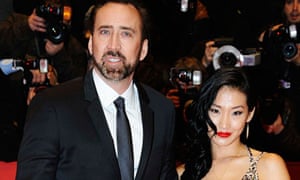
Cage with his wife Alice: 'When my mother-in-law came to the house for the first time, before even hello, all I got was, "She too young!"' Photograph: Getty Images Luca Teuchmann/WireImage
Cage looks rather surprised. "I was the lesser celebrity? Well, celebrity is a word I take great umbrage with. I'm actively anti-celebrity. I'm about creative expression. That particular relationship was really based on humour. We had a lot of laughs together. So that's what that was. Much was made about it because of her father and whatnot, but we had a simple relationship in my opinion. That was a different time in my life. Many lifetimes ago."
Things are simpler since he shed all those properties, he says. Cage once owned a portfolio including castles in Germany and England, mansions in New Orleans and Rhode Island, and an island in the Bahamas. From the outside, it looks as though he went through a period of testosterone-fuelled property acquisition. Why was that?
"I had to put the money somewhere, and I was a big believer in real estate, and I got caught up in that bubble that exploded. I thought it was real. I didn't trust stocks and I didn't trust just leaving it in the bank. I believed in real estate. So now I'm working through all that."
The properties were sold, mostly at a loss, and he now lives more modestly. "I have a tiny – and I do mean tiny – little cottage in Somerset, near Glastonbury. And I enjoy it that way. The magic of the green hills and the trees and the history. Then I have this other small lifestyle in Las Vegas. Which is a different kind of magic. That's the razzle-dazzle of the city. My wife loves it and we have good friends there. And that's it. That's my life, which is simple. And I want to keep it that way."
He gets upset when people accuse him of saying yes to any job just to pay off his debts, or the jibe that he works too much. "I'm one of those Americans who believes in working. If you've made mistakes in the past, you don't just roll over on people or cave in, you find a way through it. But in film acting, for some reason you get criticised for working."
I'm reminded of something Sean Penn said about him, based on his prolific and populist output: "He's not an actor, he's a performer."
"In a way I agree with him," Cage says. "I would rather be a performer than an actor. Acting to me implies lying. 'He's the greatest actor in the world' is like saying, 'He's the greatest liar in the world.' To perform, in my opinion, is more about emotion."
Penn wasn't being nice, though.
"Well, who knows with him? But that's OK."
Anyway, Cage says, his life these days is extremely stable thanks to Alice. "I made a very clear decision to marry out of my own zip code. I mean, way out of my own zip code. I married into another culture, and it's interesting because in Korea they call me the Son-in-Law."
Alice is 20 years his junior, a former waitress whom he met when she was 19 and working at an LA restaurant. They married, he said, so she could travel with him to South Africa while he was making Lord Of War. "You can connect the dots." Ah, an immigration matter. He adds, "And we did it because we loved each other."
If the genders were reversed, we would be talking a lot about the age gap, in which Cage is profoundly uninterested, although Alice's family were not so sanguine. "When my mother-in-law came to the house for the first time, before even hello or nice to meet you, all I got was" – he puts on a broad Korean accent – "'She too young!' And so I knew this was going to be an uphill battle." He won her around, of course.
"I don't want to go there." Cage smiles. "I have great respect for Korea and what's happening with their industry and they're hard workers and they're doing so well. Samsung is Korean. Hats off to any country that works as hard as they do."
Cage has never spent more than four days away from his son, and is trying to figure out if it's fair to take him out of school for three weeks when he films in China later this year. Has he shown Kal Nosferatu yet? "No." He smiles. "He's on a very strict diet of animation."
Many of Cage's films would, of course, be unsuitable for his son to watch.
Cage grew up watching James Bond and realised, studying Sean Connery, that a career in action will keep you working. It's not the Oscar he won for Leaving Las Vegas, or his charming performances in Adaptation and Raising Arizona that fuel demand for him. It's the roughly $2bn in revenue grossed by his blockbuster movies, some of which he had to be talked into making. "I really didn't want to make that," he says of Moonstruck. "I wanted to make Vampire's Kiss, because I was still trying to live my punk rock dreams. I did not want to be in a big splashy romantic comedy with Cher."
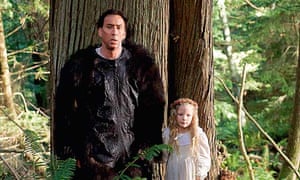
Cage in The Wicker Man: 'You don't go around doing the things that character does – in a bear suit – and not know it's absurd' PR
And then there's The Wicker Man, the recent Neil LaBute remake that I didn't think was as appalling as everyone else did. "The issue with The Wicker Man is there's a need by some folks in the media to think that we're not in on the joke. But you don't go around doing the things that character does – in a bear suit – and not know it's absurd. It is absurd. Now, originally I wanted to play that cop with a handlebar moustache and like a really stiff suit, and the producers wouldn't let me do it." Oh, Nic! "And then you would have known how in on it we were, Neil and myself. The fact that that movie has been so lambasted means there's an inner trembling and power to that movie. It has become an electromagnetic movie! And so I love it."
Cage's politics are indistinct. He has a libertarian edge, but also seems broadly liberal. I wonder if he has any sympathy for Jim Carrey, who last month criticised his own decision to appear in Kick-Ass II (Cage was in the first Kick-Ass movie) because of its violence. "You know, Jim's gonna do what Jim's gonna do. I believe in freedom of speech. I don't believe in putting a gag on creative expression. Don't go to the movie if you don't want to see violence. That's your choice. I hate slasher films, for example. I don't watch slasher films, I think they'redisgusting. But I think it's important to live in a world where there's that freedom to create whatever it is you want to create."
Where is he on gun control?
He laughs. "That is a political question."
Right. "It's something I would love to be able to answer. But I've been very neutral. By design. I know some people look down on my quietude, but I feel it would impact my ability to be an artist. If I wanted to make a movie about it one day, I don't want you to know what side I'm on when you go to that movie. It's like I, Claudius. I know this is random, but the whole reason Claudius survived and went on to be emperor is because he was smart enough to keep quiet and to build his path. Which is what I'm doing."
And so he ploughs on. His new film, The Frozen Ground, based on the true story of a serial killer who killed at least 17 women in Alaska in the 1980s, is a good, solid drama, with Cage as the cop and John Cusack as the killer. There is something quite touching about Cage's complete failure to publicise it during the interview, although it is the pretext for our meeting.
The fact is – and one can well imagine this – that Cage says he's no good when he's not working. "It's like if you have a doberman and you don't let the dog work, it's going to get a little… hyperactive. They want to please, they want to work." He has a routine to keep him steady between jobs. "I've made a new point of reading the New York Times from start to finish every day. I watch CNN. I read the Guardian. I'm trying to take in what's happening in the world. Those become resources for me."
Is he ever in danger of feeling used up?
"I can't get used up. It's not possible, because I am open to the world." Like so much of what Cage says and does, this should be cheesy, but somehow it isn't. It's the fundamental Cage paradox: the guilelessness that makes his performance.